|
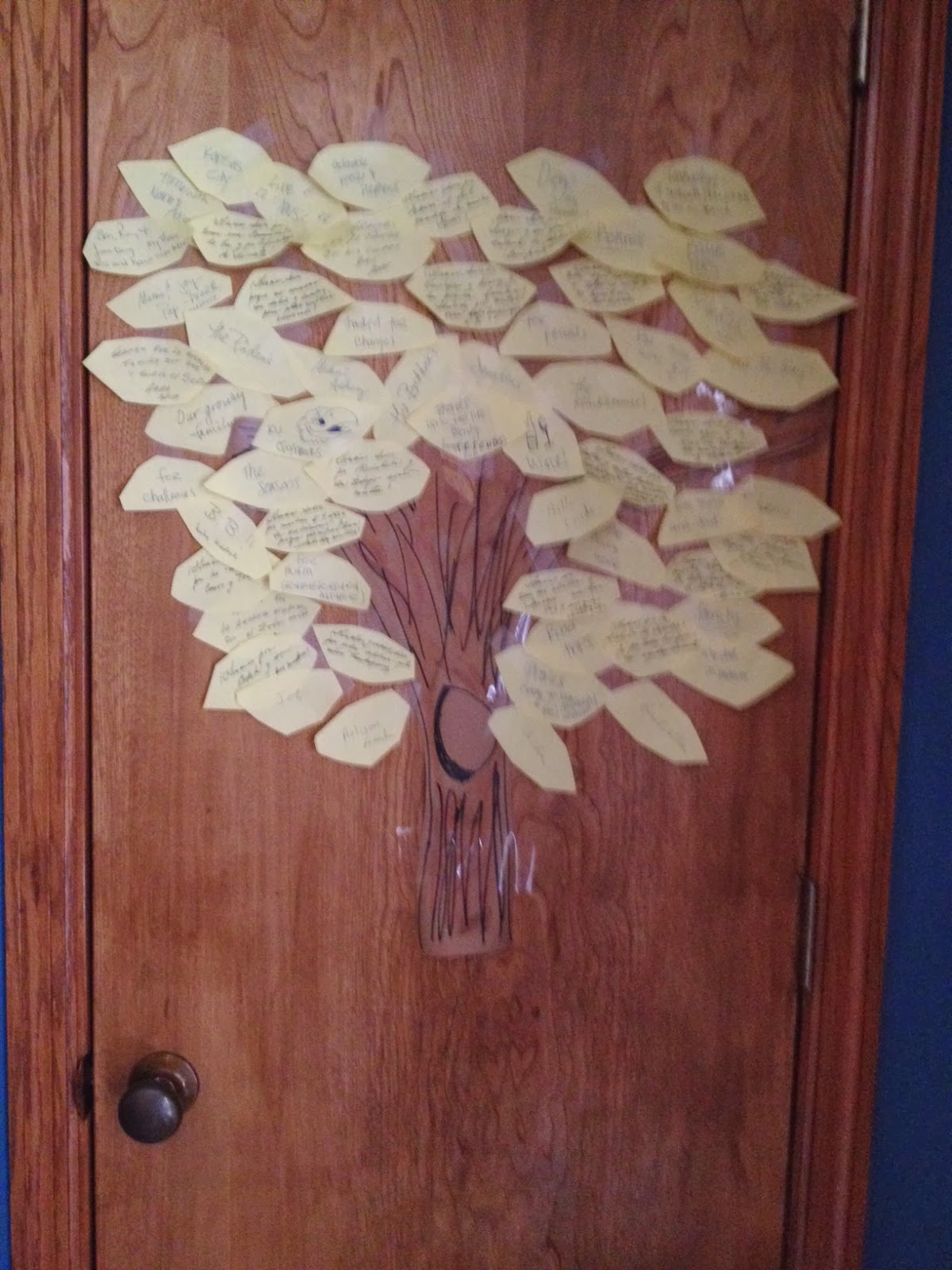
| Our family's Thanks-giving tree, 2013 |
“The answer
lies in understanding that it is these things - and these things alone, here
and now, at this moment – that truly constitute the will of God. The challenge
lies in learning to accept this truth and act upon it, every moment of every
day. The trouble is that like all great truths it seems too simple. It is there
before our noses all the time, while we look elsewhere for subtle answers. It
bears the hallmark of all divine truths, simplicity, and yet it is precisely
because it seems so simple that we are prone to overlook it or ignore it in our
daily lives.”
~ Walter J. Ciszek, S.J., “He Leadeth Me”
“The almost
embarrassingly common recurrence of barren—but favored—women in the Old
Testament is a brilliant metaphor for “I can’t do it, but God can—and will!”
This is summed up and personified in the Virgin Mary, but it is still the same
Jewish symbol. In Mary, and in us, we see our own incapacity to make spiritual
things happen by our own devices, by our own intelligence, and with our own
bodies; but I can receive, trust, and allow God to do it in me and through me. Many
translations of Luke’s “Magnificat” (Luke 1:46-55)
use the wonderful phrase “God has regarded me in my lowliness” (1:48).
This French-based word regardez means
to look at twice, or look at again, or look at deeply. Mary allows herself to
be looked at with God’s deeper and more considered gaze. When we do that, God’s
eyes always become more compassionate and merciful. And so do ours if we regard
anything.”
~ Richard
Rohr,
talk given in Tucson, Arizona,
“Being grateful
requires me to pay attention, to be present to the moment. Or in my current
favorite word, it compels me
to notice!”
This post on gratefulness prompted a rich conversation with one of my
favorite readers, my insightful father-in-law Anthony Scaperlanda (yes, the
leader and organizer of our phenomenal French pilgrimage earlier this year).
Tony pointed out that realizing a blessing or a gift is
insufficient. In other words, just noticing and appreciating something or
someone that we’re thankful for is not enough, at least in the attitude that Meister Eckhart proclaims, “if the only prayer you said in your whole life was,
‘thank you,’ that would suffice.”
In Tony’s own words, “I think that in addition to counting our
blessings and noticing actions or gifts that we receive it is also necessary to
follow Meister Eckhart and explicitly recognize what we notice or receive with
a ‘thank
you’.”
Because English is my second-learned language, any attempt to “gaze
upon” the word gratitude, trying to look at it a second time with deeper eyes, must begin by looking at it’s equivalent in Spanish.
In Spanish, the word for gratefulness and thankfulness is the same, agradecida, an adjective that
implicitly includes the person speaking (I/female am…).
This means that agradecida can describe both a
current feeling (estoy agradecida = to be grateful), as well as describe a
person’s essence (es muy agradecida = she’s an appreciate person, small things
can make her happy).
That was
interesting, but it didn’t clear things up for me any better.
Then I
decided to look at the definitions for the word gratitude in Spanish and in
English—and my “aha!” moment came to be.
The word
gratitude translates as gratitud, which in Spanish grammar
is a “sustantivo femenino,” a
(female) noun.
Here’s the
Spanish translation for gratitude:
“Sentimiento que nos
obliga a agradecer el favor recibido y corresponder a él.”
Which
literally means, a “feeling that forces us to acknowledge the favor received
and respond to it.”
“the quality or feeling of being grateful or thankful.”
That’s what I’ve been missing! While the heart of the English definition is
the feeling of being grateful, in the
Spanish definition of gratitude, the feeling is intrinsically connected to an act.
In other words, in the Spanish definition, the
feeling of gratitude obliges one to acknowledge, and respond!
Which, of course, simply brings me back to the very beginning--where all Truths come into being.
My takeaway from all this grammar talk?
That Tony is clearly right: it is not enough to notice and be thankful. Whether speaking English or Spanish, an
attitude of gratitude demands an explicit act of “thank you”!
my dear readers,
thank you for your faithfulness! I remain ever grateful to be walking this pilgrimage together, day by day.
blessings and love,
maría