Showing posts with label Fr. Walter J. Ciszek. Show all posts

Monday, August 4, 2014

you can't fake surrender


It is I” ~Mathew 14:27

“God is in all things, sustains all things, directs all things. [To] see his will in all things was to accept each circumstance and situation and let oneself be borne along in perfect confidence and trust… By renouncing, finally and completely, all control of my life and future destiny, I was… freed from anxiety and worry, from every tension, and could float serenely upon the tide of God’s sustaining providence in perfect peace of soul.” ~Walter J. Ciszek, S.J.

michael & michelle walking the Italian beach

It is often only in retrospect that life can be seen accurately. A good example is looking back and remembering the worse, most difficult, most painful moments in my life, or other critical life changing events.

Days, months, or more likely, years later, I eventually recognize that one of the graces—or dare I call them blessings? —of these moments is how clearly I later see the hand of God in the details of my life.

A few years when Michael, Michelle and I fell asleep on a deserted beach in southern Italy and, while we were sleeping, our travel bag stolen. Not only did the bag have our passports, money, credit cards, camera, it also had the keys to our rental car, so we weren’t going anywhere!

My honest but bold prayer that day still makes me laugh.  As I walked up and down the beach cussing under my breath and checking every trash bin in the hope that some of our things had been dumped and left behind, the words I burst out loud were more of a dare than a prayer: “Oh fine. Let’s see how you’re going to get us out of this one!”

In God’s eternal, faithful, and even humorous love, the answer was immediate.  A young couple down the beach came to ask how they could help us. They drove us to the nearby police station, and even took us to the flat that was our home for the week, even though it was several towns away. We are now Facebook friends with our Italian angels.

On a more serious note, during recovery from surgery on my cervical spine eight years ago, I remember feeling so completely empty, powerless, and broken that my only prayer was one of surrender. I felt lonely and vulnerable, yes. But I wasn’t asking God for help as much as keenly aware that only in Him, through Him, with Him, could I continue living. It was both sobering and liberating.

But why do I wait for a moment when I feel completely helpless to trust the God who loves me so faithfully day after day? How can I make the shift in attitude from having confidence in God because that’s what I should do—to truly and completely surrendering myself to God in trust with every detail of my life?

The thing is that I don’t want my actions and prayers to be based on a religious or pious definition of what or how a good Catholic Christian should act.

What I really want is that serenity Father Ciszek describes and that I've experienced during crisis, the type that frees me from anxiety and worry. I want to surrender to God—because I am loved, and that changes everything.

I want love to be my catalyst.


Wednesday, January 22, 2014

change #2, #SmallMerciesMiércoles: I'm grateful for feet, even when hopping on one leg

view from my office today!


People with arthritis often claim they can predict the weather, based on their joint pain level, and with good reason. Studies show a variety of weather factors can increase pain, especially changes… in barometric pressure (especially falling) and in temperature (especially lowering). 
A study from Tufts University in 2007 found that every 10-degree drop in temperature corresponded with an incremental increase in arthritis pain. In addition, relatively low barometric pressure, low temperatures and precipitation can increase pain. Researchers aren’t sure why this happens. They suspect certain atmospheric conditions increase swelling in the joint capsule.
+   +   +   +   +
"'Man is a creature composed of body and soul.' We have recited that truth from the day we first learned our catechism. But until the body fails us, or pains us, or forces itself upon our attention by some little twinge or complete collapse, we tend to take for granted this first and most precious of God's gifts to man or to give it short shrift."  
"What came to me in the prison camps was a tremendous respect and love for the poor old body. It was the body that bore the brunt of all suffering, though the soul might well experience anguish. And it was the body that had to sustain you, for all the strength of will and determination it might have. It was the body that felt the sting of the wind, the bite of the cold, the cramp of aching muscles, the raw lash of cracked and bleeding flesh, the gnawing agony of hunger in the belly, the soreness and numbness of overtaxed sinews... and yet somehow it always managed to get you through one more day. It was the body that underwent the suffering, felt the agony, and carried the heavy weight across its shoulders of this daily passion and slow death of inhuman work."  
"It is in the body that we exist and work out our salvation. It is in the body that we see and take delight in the beauties of God's created universe, and in the body that we ourselves bear the marks of Christ's passion."
"God by his Incarnation took on a human body."  
"For each of us salvation means no more and no less than taking up daily the same cross of Christ, accepting each day what it brings as the will of God, offering back to God each morning all the joys, works, and sufferings of that day. But those are abstract words."  
"What it means, in practice, is spelled out as always by the poor old body. It means getting up each morning and going to bed exhausted. It means the routine, not the spectacular. It can mean drudgery, pain, putting aside pleasures, happiness, or the love the human heart craves until another time, so that what is necessary at the moment can be done. It means working for others, touching the lives of others, through the medium of the body."

~Walter Ciszek, S.J., 

+     +     +     +

I am hopping on one leg today, literally. I’m not sure what’s causing it, exactly, but I’m having pain and swelling issues with my left foot. 

I don't even have a weird, fun story to go with it! There’s nothing broken, so it seems to be related to the inflammation problems related to my condition.

Which, believe it or not, leads me to the next “adjustment” that I’m proposing to myself!

Yesterday I wrote about keeping holy the Sabbath day, and my commitment to un-plug from technology on Sundays. In addition, I have decided to also work at being more regular with my writing time, including the frequency of the blog—and yes, within my physical abilities!

I’ve written before about the importance of  thankfulness and gratefulness, and how this attitude affects my life. And I’ve participated, however briefly (so far!), in CatholicMom.com’s #SmallSuccess Thursday Project.

So it seems like a natural sequel to developing my writing routine if I include weekly posts on what I’m grateful for, with specifics.  More on the details of this idea over the next few weeks, but for today… here’s what I’m calling #SmallMerciesMiércoles, which I will publish (¡con la ayuda de Dios!) every Wednesday.

#1   I’m grateful that I did not break any bones in the foot of my “poor old body

#2   I’m grateful for the opportunity this situation gives me to stay home, put up my feet (ha!), and write!

#3   I am also grateful for my body’s reminder that God is here, incarnate, in every minute detail of my life and myself!


Ps. For those of you who’ve reached the age where your body helps you predict the weather – here are two helpful online sources to help you verify what you’re already feeling:

Over at ArthritisToday.org, an Arthritis Index based on a proprietary forecast by the meteorologists at www.AccuWeather.com. Click here

and over at weather.com, you can type in your zip code and get your “local aches & pains forecast
or even peek at the “National aches & pains map”

The “aches & pains” forecast looks great for me today!  
What about your neck of the woods?

Friday, November 29, 2013

dear readers, estoy agradecida...


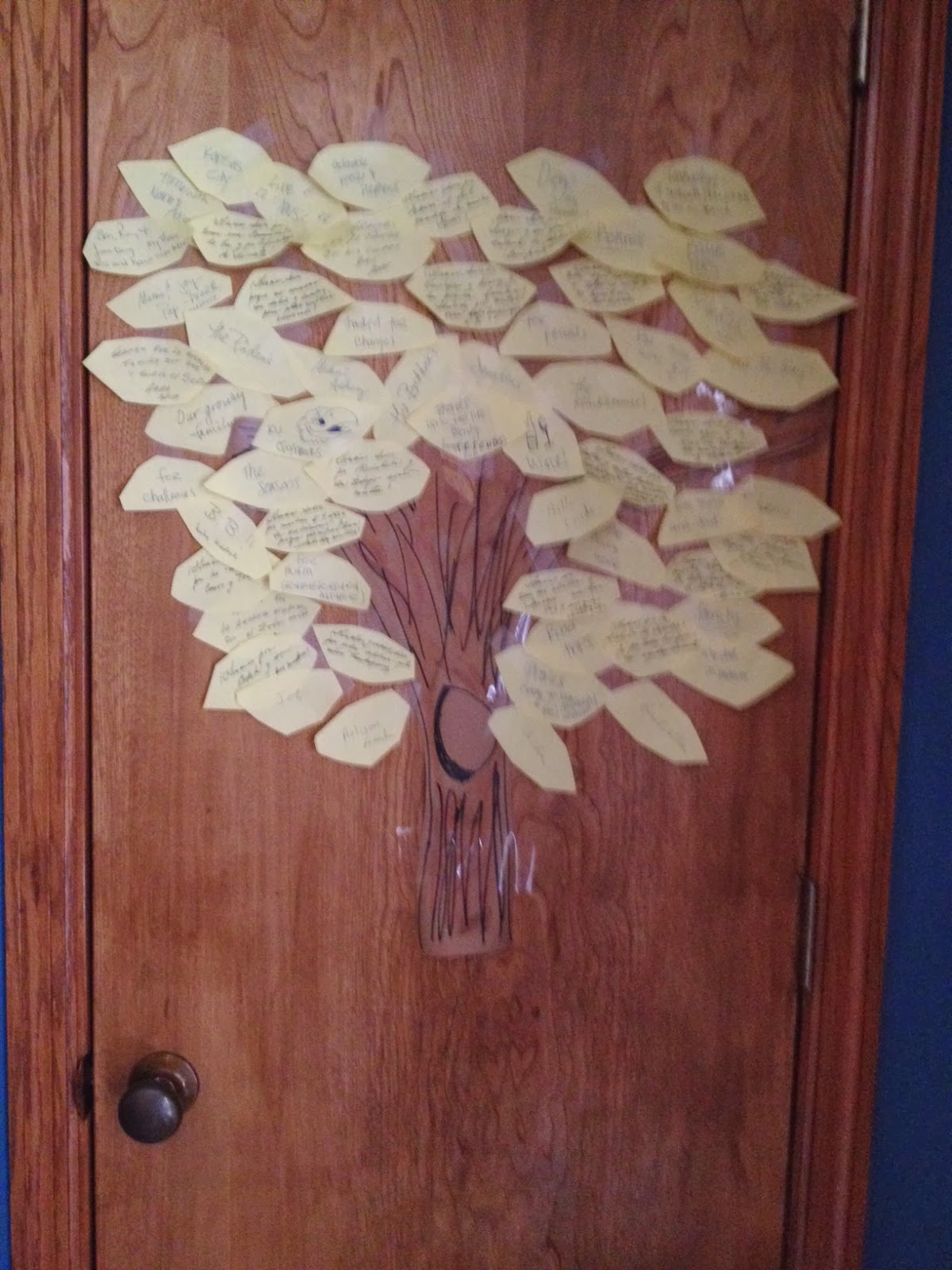
Our family's Thanks-giving tree, 2013
The answer lies in understanding that it is these things - and these things alone, here and now, at this moment – that truly constitute the will of God. The challenge lies in learning to accept this truth and act upon it, every moment of every day. The trouble is that like all great truths it seems too simple. It is there before our noses all the time, while we look elsewhere for subtle answers. It bears the hallmark of all divine truths, simplicity, and yet it is precisely because it seems so simple that we are prone to overlook it or ignore it in our daily lives.”

 
~ Walter J. Ciszek, S.J., “He Leadeth Me”
The almost embarrassingly common recurrence of barren—but favored—women in the Old Testament is a brilliant metaphor for “I can’t do it, but God can—and will!” This is summed up and personified in the Virgin Mary, but it is still the same Jewish symbol. In Mary, and in us, we see our own incapacity to make spiritual things happen by our own devices, by our own intelligence, and with our own bodies; but I can receive, trust, and allow God to do it in me and through me. Many translations of Luke’s “Magnificat” (Luke 1:46-55) use the wonderful phrase “God has regarded me in my lowliness” (1:48). This French-based word regardez means to look at twice, or look at again, or look at deeply. Mary allows herself to be looked at with God’s deeper and more considered gaze. When we do that, God’s eyes always become more compassionate and merciful. And so do ours if we regard anything.”
~ Richard Rohr, 
talk given in Tucson, Arizona, 


I have been pondering, in the “regardez” sense of the word, the idea of gratefulness.

In a recent post I noted the important practice of gratitude, and how, 
Being grateful requires me to pay attention, to be present to the moment. Or in my current favorite word, it compels me to notice!” 
This post on gratefulness prompted a rich conversation with one of my favorite readers, my insightful father-in-law Anthony Scaperlanda (yes, the leader and organizer of our phenomenal French pilgrimage earlier this year).

Tony pointed out that realizing a blessing or a gift is insufficient. In other words, just noticing and appreciating something or someone that we’re thankful for is not enough, at least in the attitude that Meister Eckhart proclaims, “if the only prayer you said in your whole life was, ‘thank you,’ that would suffice.”

In Tony’s own words, “I think that in addition to counting our blessings and noticing actions or gifts that we receive it is also necessary to follow Meister Eckhart and explicitly recognize what we notice or receive with a ‘thank you’.”

Because English is my second-learned language, any attempt to “gaze upon” the word gratitude, trying to look at it a second time with deeper eyes, must begin by looking at it’s equivalent in Spanish.

In Spanish, the word for gratefulness and thankfulness is the same, agradecida, an adjective that implicitly includes the person speaking (I/female am…).

This means that agradecida can describe both a current feeling (estoy agradecida = to be grateful), as well as describe a person’s essence (es muy agradecida = she’s an appreciate person, small things can make her happy).

That was interesting, but it didn’t clear things up for me any better.

Then I decided to look at the definitions for the word gratitude in Spanish and in English—and my “aha!” moment came to be.

The word gratitude translates as gratitud, which in Spanish grammar is a “sustantivo femenino,” a (female) noun.

Here’s the Spanish translation for gratitude:
Sentimiento que nos obliga a agradecer el favor recibido y corresponder a él.” 
Which literally means, a “feeling that forces us to acknowledge the favor received and respond to it.”

By contrast, the word “gratitude” in English is defined as, 
the quality or feeling of being grateful or thankful.”
That’s what I’ve been missing!  While the heart of the English definition is the feeling of being grateful, in the Spanish definition of gratitude, the feeling is intrinsically connected to an act.

In other words, in the Spanish definition, the feeling of gratitude obliges one to acknowledge, and respond!

Which, of course, simply brings me back to the very beginning--where all Truths come into being.

My takeaway from all this grammar talk? That Tony is clearly right: it is not enough to notice and be thankful.  Whether speaking English or Spanish, an attitude of gratitude demands an explicit act of “thank you”!


my dear readers, 
thank you for your faithfulness! I remain ever grateful to be walking this pilgrimage together, day by day.
blessings and love,
maría

Monday, November 11, 2013

the big red sky


“There is a lot of science one can read up on about what makes a vivid, colorful sunset. In a simplistic nutshell, sunlight is “bent” as it passes through our atmosphere. Blue light is affected the most (shorter wave length), while red (longer wave length) is affected the least. The Rocky Mountains also absorb a lot of blue light, leaving us with the brilliant reds and yellows we see here in Oklahoma.”


“The simple soul who each day makes a morning offering of ‘all the prayers, works, joys, and sufferings of this day’ – and who then acts upon it by accepting unquestioningly and responding lovingly to all the situations of the day as truly sent by God-has perceived with an almost childlike faith the profound truth about the will of God.”


~Walter J. Ciszek, SJ, He Leadeth Me


Thanks to our long, low horizons (as well as other scientific reasons beyond my pay grade), we are blessed with truly stunning sunsets in central Oklahoma.

I am often overwhelmed by the big sky’s brilliant colors at that magic hour, and have to stop whatever I’m doing, or even pull over if I’m driving, to simply watch the day’s final moments of light converting our flat horizon into a Monnet-like canvas of bright color.

If I don’t pay attention, however, the big bright sun makes it easy to focus merely on the western horizon—and miss the impressive color displays taking place as the light reflects on the opposite side of the sky!

The biggest, brightest colors are often hiding, like a surprise gift, on the other side of the celestial canvas.

It made me ponder about how much this reflects the reality of God’s hand in the details of my life. I get so focused on a particular moment or event, that I forget that God’s reality, attention, and mercy is much bigger, generous, brighter, and loving that anything I can conceive or imagine.

God paints the full horizon, not merely where my eyes seem to focus.

Wherever you are when you read this, may you enjoy sunshine and beauty this autumn day! Here in central Oklahoma, we are preparing for a massive weather system heading our way that will drop our temperature by 50 degrees!


Tuesday, April 30, 2013

is this too simple, or am I just afraid to believe it?


At the risk of revealing too much about the way my brain connect things, two very different articles today reminded me how much I/we try to control our environment and the world we live in.

The first one from our local news channel is anticipating the unpredictable weather that we MAY (emphasis on MAY) encounter these first two weeks of the month of May, forewarning us that we're approaching the worst week, the peak time, for tornadoes for those of us living in Oklahoma’s tornado ally.  You can see the full article here.

Published in the Wall Street Journal, the second article examines the science of neurocriminology, using neuroscience to understand—and prevent—crime. According to the article, “brain-imaging techniques are identifying physical deformations and functional abnormalities that predispose some individuals to violence.”  

The article notes that more than 100 studies of twins and adopted children confirm that,  “about half of the variance in aggressive and antisocial behavior can be attributed to genetics.” If we have, indeed, uncovered the anatomy of violence, what are we as a culture willing to do to prevent crime and aggresion?

I’m not dissing science or our attempt to understand our environment and/or ourselves.  My point here is that I’m struck by the perhaps primal urge to not only understand, but also predict in order to control (aka. prevent) the things that cause us the most fear.

ancient pictograph, spiral
Albuquerque, NM

Whether tornadoes, earthquakes or fierce storms, who among us doesn’t get spooked by the unpredictability of acts of nature?

And who can claim to not be at some level anxious about the persistent violent acts that human beings are capable of doing?

There is only one way I know to prevent anxiety and fear, especially about all that is out of my control: the genuine, fundamental awareness that I live in God’s hand—at every single moment. This is my source of peace. Is this too simple, or am I just afraid really to believe it?
“For what can ultimately trouble the soul that accepts every moment of every day as a gift from the hands of God and strives always to do his will? ‘If God is for us, who can stand against us?’  Nothing, not even death, can separate us from God. Nothing can touch us that does not come from his hand, nothing can trouble us because all things come from his hand. 
Is this too simple, or are we just afraid really to believe it, to accept it fully and in every detail of our lives, to yield ourselves up to it in total commitment? This is the ultimate question of faith, and each must answer it for himself in the quiet of his heart and the depths of his soul. But to answer it in the affirmative is to know a peace, to discover a meaning to life that surpasses all understanding.


 ~Father Walter J. Ciszek, S.J.
He Leadeth Mep. 201-202  

+   +   +   +   +

NOTE:  Stay tuned for a Q&A with Marge Fenelon, 
author of "Imitating Mary: Ten Marian Devotions for the Modern Mom"

coming up on Thursday, May 2

Also, you can WIN a copy of Marge's book, Imitating Mary
by leaving a message on this blog that day!