Showing posts with label gratitude. Show all posts

Wednesday, January 29, 2014

Small Mercies Miércoles: Today I'm grateful for...


Elena at the Oklahoma City Zoo
“For years, I subscribed to the notion of an “attitude of gratitude.” I’ve since learned that an attitude is an orientation or a way of thinking and that “having an attitude” doesn’t always translate to a behavior… 
So, what does a gratitude practice look like? The folks I interviewed talked about keeping gratitude journals, doing daily gratitude mediations or prayers, creating gratitude art, and even stopping during their stressful, busy days to actually say these words out loud: ‘I am grateful for…’ When the Wholehearted talk about gratitude, there are a whole bunch of verbs involved. 
~ Brené Brown, “The Gifts of Imperfection”

That last line jumps out of the page at me,

“When the Wholehearted talk about gratitude, there are a whole bunch of verbs involved.”

Although our young adult children and I don’t always agree on the facts behind their memories of growing up, I think all four would probably remember just how much their mom harped on the statement: “attitude is everything.

I once wrote it in big letters on the glass of the French doors in our dining room, a declaration of expectation for every family member’s behavior!

The truth is that when teenagers turn melancholic and moody, there are few—if any—practical things that a parent can say to make them change. But urging/encouraging/demanding an “attitude of gratitude” was tops on my list of behavior expectations for them.

I still agree.

But what I hear in Brené Brown’s statement is that embracing an understanding of gratitude and thankfulness is not only about exploring the English language, as I wrote about here.

We can all agree that gratitude is an essential ingredient to living in joy, orienting my heart toward God with thanksgiving for the blessings in our lives. But how do we GET it?

It’s the difference between a noun and a verb!

This is why I’ve committed to Small Mercies Miércoles/Wednesdays.  It’s my way of taking note of the daily doses of grace that happen in the ordinary moments of my life. 

And by the way, I picked Wednesdays because the middle of the week is a good place to stop and assess my attitude about the week—and take action for the second half!

Today.

my Twinkie Cecilia, snuggling on my shoulder at Sofia's baptism!
I am grateful for -- the unique and intimate opportunity of getting to know each of my grandchildren, face-to-face. At this time last year, my Holy Trinity of grandchildren lived in Milwaukee, and I spent a lot of my time and energy traveling to Wisconsin to visit.  But all that has changed. Not only are they living just 25 minutes north of me, there’s a new grand for me to get to know, baby Sofia Maria (4 weeks old tomorrow!).   

What about you? What are you grateful for today?


Friday, November 29, 2013

dear readers, estoy agradecida...


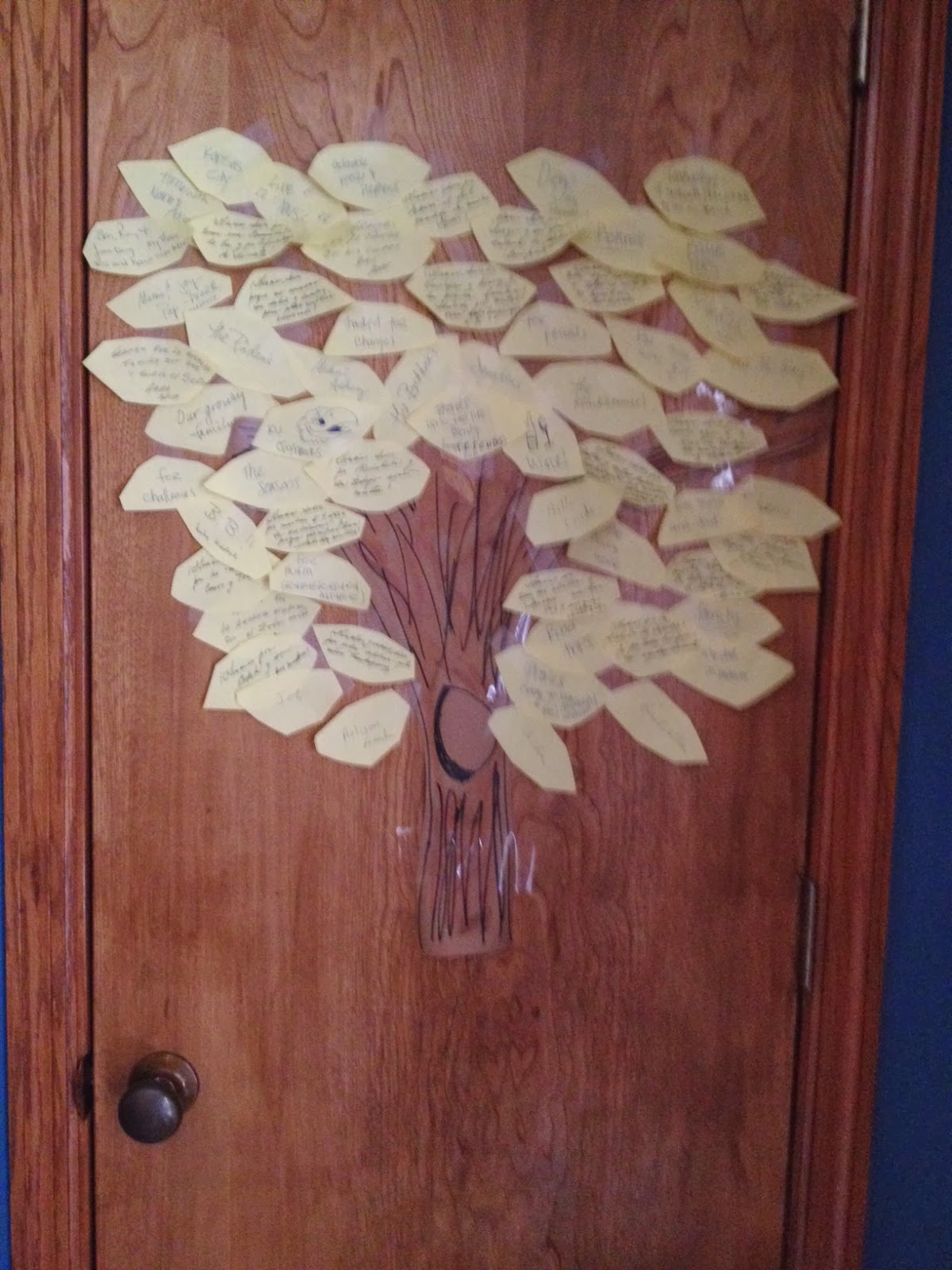
Our family's Thanks-giving tree, 2013
The answer lies in understanding that it is these things - and these things alone, here and now, at this moment – that truly constitute the will of God. The challenge lies in learning to accept this truth and act upon it, every moment of every day. The trouble is that like all great truths it seems too simple. It is there before our noses all the time, while we look elsewhere for subtle answers. It bears the hallmark of all divine truths, simplicity, and yet it is precisely because it seems so simple that we are prone to overlook it or ignore it in our daily lives.”

 
~ Walter J. Ciszek, S.J., “He Leadeth Me”
The almost embarrassingly common recurrence of barren—but favored—women in the Old Testament is a brilliant metaphor for “I can’t do it, but God can—and will!” This is summed up and personified in the Virgin Mary, but it is still the same Jewish symbol. In Mary, and in us, we see our own incapacity to make spiritual things happen by our own devices, by our own intelligence, and with our own bodies; but I can receive, trust, and allow God to do it in me and through me. Many translations of Luke’s “Magnificat” (Luke 1:46-55) use the wonderful phrase “God has regarded me in my lowliness” (1:48). This French-based word regardez means to look at twice, or look at again, or look at deeply. Mary allows herself to be looked at with God’s deeper and more considered gaze. When we do that, God’s eyes always become more compassionate and merciful. And so do ours if we regard anything.”
~ Richard Rohr, 
talk given in Tucson, Arizona, 


I have been pondering, in the “regardez” sense of the word, the idea of gratefulness.

In a recent post I noted the important practice of gratitude, and how, 
Being grateful requires me to pay attention, to be present to the moment. Or in my current favorite word, it compels me to notice!” 
This post on gratefulness prompted a rich conversation with one of my favorite readers, my insightful father-in-law Anthony Scaperlanda (yes, the leader and organizer of our phenomenal French pilgrimage earlier this year).

Tony pointed out that realizing a blessing or a gift is insufficient. In other words, just noticing and appreciating something or someone that we’re thankful for is not enough, at least in the attitude that Meister Eckhart proclaims, “if the only prayer you said in your whole life was, ‘thank you,’ that would suffice.”

In Tony’s own words, “I think that in addition to counting our blessings and noticing actions or gifts that we receive it is also necessary to follow Meister Eckhart and explicitly recognize what we notice or receive with a ‘thank you’.”

Because English is my second-learned language, any attempt to “gaze upon” the word gratitude, trying to look at it a second time with deeper eyes, must begin by looking at it’s equivalent in Spanish.

In Spanish, the word for gratefulness and thankfulness is the same, agradecida, an adjective that implicitly includes the person speaking (I/female am…).

This means that agradecida can describe both a current feeling (estoy agradecida = to be grateful), as well as describe a person’s essence (es muy agradecida = she’s an appreciate person, small things can make her happy).

That was interesting, but it didn’t clear things up for me any better.

Then I decided to look at the definitions for the word gratitude in Spanish and in English—and my “aha!” moment came to be.

The word gratitude translates as gratitud, which in Spanish grammar is a “sustantivo femenino,” a (female) noun.

Here’s the Spanish translation for gratitude:
Sentimiento que nos obliga a agradecer el favor recibido y corresponder a él.” 
Which literally means, a “feeling that forces us to acknowledge the favor received and respond to it.”

By contrast, the word “gratitude” in English is defined as, 
the quality or feeling of being grateful or thankful.”
That’s what I’ve been missing!  While the heart of the English definition is the feeling of being grateful, in the Spanish definition of gratitude, the feeling is intrinsically connected to an act.

In other words, in the Spanish definition, the feeling of gratitude obliges one to acknowledge, and respond!

Which, of course, simply brings me back to the very beginning--where all Truths come into being.

My takeaway from all this grammar talk? That Tony is clearly right: it is not enough to notice and be thankful.  Whether speaking English or Spanish, an attitude of gratitude demands an explicit act of “thank you”!


my dear readers, 
thank you for your faithfulness! I remain ever grateful to be walking this pilgrimage together, day by day.
blessings and love,
maría

Thursday, October 24, 2013

noticing alliteration, texts and sunshine: it's #SmallSuccess Thursday

"We can only be said to be alive in those moments when our hearts are conscious of our treasures."
~Thornton Wilder
“If the only prayer you said in your whole life was, "thank you," that would suffice.” 
~Meister Eckhart 
If it's true that we have to hear something stated seven times before we actually hear it, perhaps that explains the wide assortment of sources reminding us, as a culture, of the obvious fact that gratefulness is important.

Take for example, the field of science. Last year, the University of California Berkeley announced a $3.1 million (yes, I said millions!) research study on gratitude, explaining that their Greater Good Science Center researchers would be able to study “the psychology, sociology, and neuroscience of well-being and how we foster a more thriving, resilient, and compassionate society.”

And a recent Psychology Today article that emphasized: “Gratitude is a sentiment we'd all do well to cultivate, according to positive psychologists, mental health clinicians and researchers who seek to help everyone create more joy in life. Feeling thankful and expressing that thanks makes you happier and heartier—not hokier.”

This is not rocket science. We hardly need a study to tell us that the practice of counting our blessings is good for us.

But perhaps we do need to hear it everywhere—stressed by doctors, psychologists, researchers, and neuroscientists, before we—before I—embrace the practice with my whole heart.

Being grateful requires me to pay attention, to be present to the moment. Or in my current favorite word, it compels me to notice!

So -- I am excited this week to join the #SmallSuccess Thursday project at CatholicMom.com. Here are my simple 3 Small Successes.

May noticing them help me grow in gratitude for the abundant blessings in my life! 
Amen.

  • #1, for my husband’s daily handwritten, alliterated messages on the board on our fridge – which I confess, make me giggle. Today’s announcement: thunderous thoughtful thriving Thursday!
  • #2, for the texts, photos and emails from my four young adult children—sometimes practical, often funny, and always loving.  I am so grateful that they take the time to connect with me during their busy days!
  • #3, the weather this afternoon in central Oklahoma: 60 degrees of sunshine. Enough said.

Note: 
I will write soon -- tomorrow? -- about our wonderful experience at St. Mary of the Annunciation in Illinois this past weekend!


Monday, October 29, 2012

In Arrupe's words: enough said


“Nothing is more practical than
finding God, than
falling in Love
in a quite absolute, final way.
What you are in love with,
what seizes your imagination, will affect everything.
It will decide
what will get you out of bed in the morning,
what you do with your evenings,
how you spend your weekends,
what you read, whom you know,
what breaks your heart,
and what amazes you with joy and gratitude.
Fall in Love, stay in love,
and it will decide everything.”

            ~Rev. Pedro Arrupe, S.J. (1907-1991) 
in "Finding God in All Things: A Marquette Prayer Book" © 2009

Tuesday, October 23, 2012

Saintliness


80,000 pilgrims filled St. Peter's Square on
October 21, 2012, for the canonizations

Seven new saints this week. How wonderful is that! 

I have always loved the stories of the saints. As a young child, it is no wonder that I especially loved reading about the ones that messed up in their lives—yet still came to have lives holy enough to be declared official saints.


A few years ago in her wonderful blog, Creo en Dios!, my friend and spiritual director Susan Stabile quoted author Ron Rolheiser and his unusual definition of saintliness:
 “Gratitude is the ultimate virtue—even more so than love. What makes someone a saint is gratefulness. Because love is only real when it’s fueled by gratitude. If it’s fueled by resentment or duty, its’ going to cause resentment or be manipulative. If someone asks, ‘Who’s the most saintly person you know?’ I would say the most grateful person. Gratitude becomes the fuel for everything. It’s not just coincidental that the word eucharist means ‘gratitude’.”
I know—and understand this to be true–with my head, and I do believe it with my whole heart. But there are days when my body hurts, and it feels so draining that my mind can’t think straight. Gratitude feels very distant.


And it’s not that I don’t WANT to be grateful. But all my energy becomes focused on ascertaining how to feel better, how to control the pain. It’s all I think about. It consumes me. I can’t even begin to tell you how else I am feeling—or if there is anything else that I feel.

It is days like this when I find great comfort in the story of the Greek woman, the Syrophoenician, who heard about Jesus and simply “came and fell at his feet” [Mark 7:25].

When I don’t know what I feel. When I can’t think what words to pray. All I really need to do is fall at Jesus’ feet, as I am, and beg him with my presence. This is more than enough prayer.