Showing posts with label saints. Show all posts

Thursday, May 13, 2021

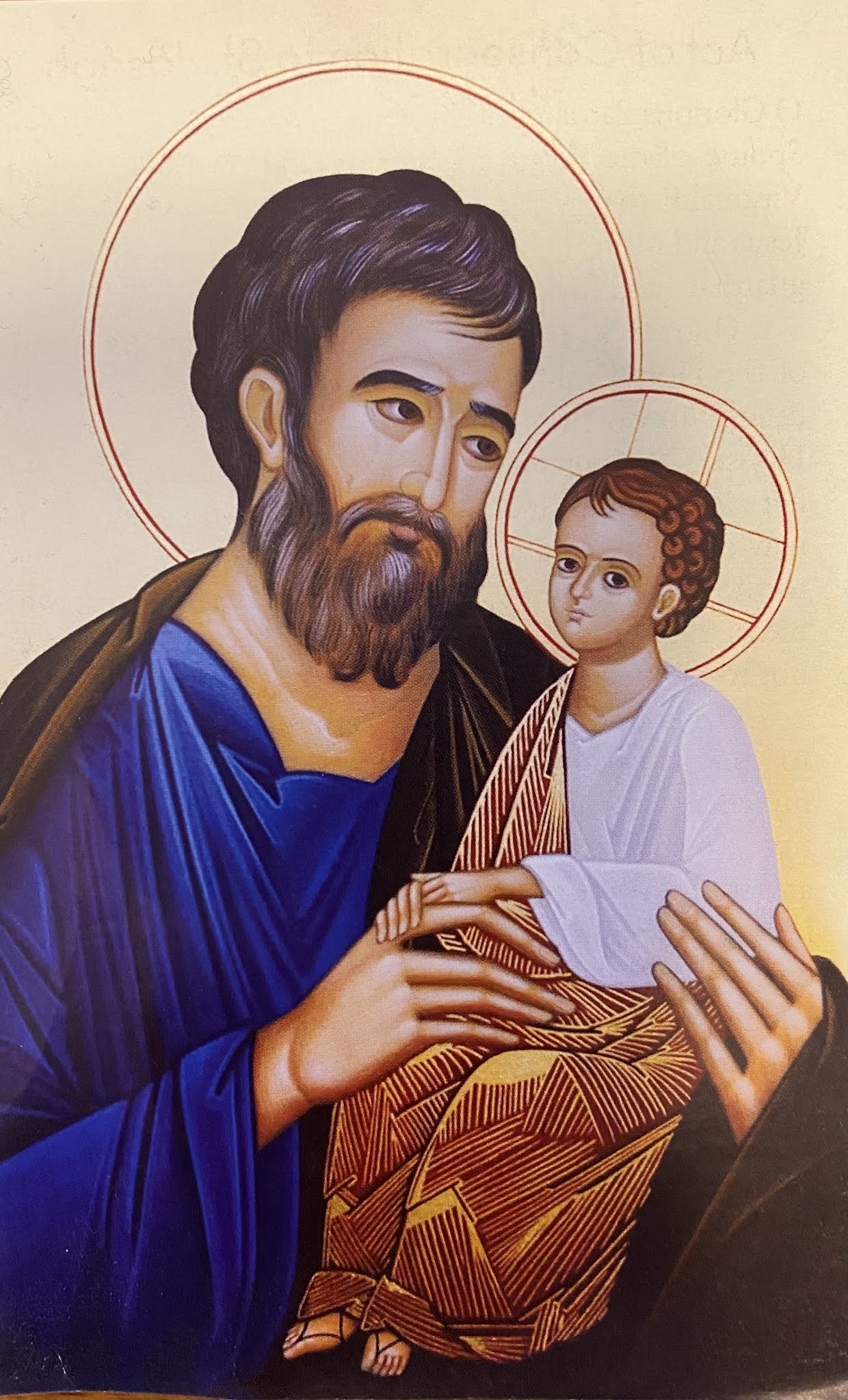
as you might have heard, it's the year of St. Joseph!


IMPORTANT NOTE:

The platform that I’ve been using for the past nine years – Blogger – is doing away with the “follow by email” widget that allows you (if you’re interested!) to receive my Day by Day with Maria Blog as an email. The bottom line is that, come July, you will NOT be receiving my blog as an email whenever I have a new post.  


I am pondering what options I have available, but so far nothing stands out. The most likely scenario is that I have to change sites… so, stay tuned, and I will keep you posted! 


Repeat after me… Change is good change is good change is good change is good change is good…


+     +     +


"To other saints the Lord seems to have given grace to succor us in some of our necessities but of this glorious saint my experience is that he succors us in them all and that the Lord wishes to teach us that as He was Himself subject to him on earth (for, being His guardian and being called His father, he could command Him) just so in Heaven He still does all that he asks. This has also been the experience of other persons whom I have advised to commend themselves to him; and even to-day there are many who have great devotion to him through having newly experienced this truth." 


~St.Teresa of Avila on her devotion to St. Joseph


When my son and his wife had their first baby, one of my closest friends enjoyed referring to them as my holy family. “How is your holy family?” “When will you see your holy family again?” When they had twins a couple of years later, she switched to calling them my holy trinity of grandkids. 


Rather than detracting from the theological significance of these concepts, using these meaningful faith labels to describe my personal family brought the ideas to life in a unique way for me. 


My son’s family certainly was – and remains – a symbol of all “holy families,” ordinary mothers and fathers striving to live holy lives as they put into practice their faith within the quotidian and ordinary work of our lives. 


In Patris corde (With a Father’s Heart), an apostolic letter which Pope Francis wrote against the backdrop of the Covid-19 pandemic, the Holy Father emphasized that our shared experience of the pandemic has helped us see more clearly the importance of “ordinary” people who, though far from the limelight, exercise patience, perseverance, faithfulness, and offer daily hope to those around them.


In this way, said Pope Francis, they resemble Saint Joseph, “the man who goes unnoticed, a daily, discreet and hidden presence – an intercessor, a support and a guide in times of trouble. Saint Joseph reminds us that those who appear hidden or in the shadows can play an incomparable role in the history of salvation. A word of recognition and of gratitude is due to them all.”


I find especially profound the images where St. Joseph is depicted actively taking care of his family: The flight into Egypt; walking to Bethlehem; Teaching Jesus carpentry. There is one illustration, in particular, that I place prominently over my mantle every Christmas season. It depicts Mary in the background, enjoying much-needed rest after giving birth, and Joseph holding newborn Jesus in his arms, lovingly gazing at him.  These are moments in the life of the holy family that I can connect with, instances where a mother and father quietly and faithfully live out their parenting vocation.


In his reflection about Joseph of Nazareth and “the mission entrusted to him by God’s providence,” Joseph was for Jesus “the earthly shadow of the heavenly Father,” Pope Francis concluded. “He watched over him and protected him, never leaving him to go his own way.” 


To serve in the shadows, while becoming earthly shadows of God for our families, this is the call for each of us, whatever our season of life. 


And in this we grow in trust, like Joseph, whose every Gospel story concludes with: he gets up, takes Jesus and his mother, and does what God commanded of him.


St. Joseph, please pray for us, that we, too, may get up, 

serve our loved ones, and do the will of the Father.


+     +     +


This column was first published in the May 2021 issue of Liguorian Magazine, as the regular  column, “Just Live It”


Tuesday, February 16, 2021

you are cordially invited to a Dinner Party with the Saints


I have long admired Woodeene Koenig-Bricker, her talent, quest for innovation, and expert knowledge -- as a writer, author, history buff, editor, archeology lover. But she has outdone herself in this latest book, “Dinner Party with the Saints.” 


Wow, what a creative endeavor! 


In this imaginative book, Woodeene gathers 16 holy women and men around a dinner table, as they wait in heaven together for the arrival of the One special guest. 


The group of saints — from St. Josephine Margaret Bakhita and St. John the Baptist, to St. Kateri Tekakwitha and St. Andrew Kim Taegon— is as varied and intriguing as the premise of the book!


Each chapter includes a short bio, favorite saint quote, legends and miracles surrounding the saint, prayers, and explanations of the historical time and culture when they lived. Here’s a sample chapter, about St. Peter! 


But wait, that’s not all! Each saint’s story also includes a uniquely appropriate dinner recipe, courtesy of Woodeene's partner, classically-trained chef Celia Murphy.  


Seriously, what a creative combination. 


I especially love the humorous interaction between the saints, such Josephine Bakhita and Augustine bonding over both being from the African continent. 


Want to know more about Woodeene? Click here!


And to learn more about recipe creator Celia Murphy? Click here!


And of course, here's where you can get the book, Paraclete Press. 


Tuesday, November 1, 2016

why I need saints


Last year Archbishop Oscar Arnulfo Romero y Galdamez of El Salvador was beatified. You may recall that Archbishop Romero was assassinated in 1980 as he celebrated Mass, just a day after pleading and ordering soldiers to stop killing innocent Salvadorians.

Ever since I first heard the news announcing Archbishop Romero’s beatification, I have found myself pondering why I need saints in my life.

I don’t mean just the holy people that have graced my spirit and shaped my life, like my dear Pat Stankus or my grandmother Josefita—but also the kind of holy that is proclaimed a saint by the universal Church.

First, let me be clear. I’m not trying to articulate—or defend—an intellectual, theological concept regarding sainthood. 

What I’ve been asking myself is much more tangible... and self-centered! I've been pondering, what is the point of proclaiming saints? what difference do these saints make to me?

Here’s what I’ve come up with...
  • I need saints because they intercede with God on my behalf. Theirs is the sort of passionate pleading akin to the mother I met years ago in Austin whose son was on death row in Huntsville. When the Governor of Texas refused to see her in person to hear her plead for a stay of his execution, the determined mother set up a tent to live in across the street from the Governor’s mansion, and she invited the local press, the local bishop, and anyone else who would listen, to join her in prayer and in peaceful demonstration.  Who doesn’t need this sort of passionate intercession?
  • I need saints because they connect me to others—across time and geography—and this constantly reminds me that my faith is little “c” catholic. I am not alone in my quest and desire to live for God. I have a cloud of witnesses that share with me this longing for God! And in addition, their stories remind me that -- no matter how much I screw that up (if you haven't heard, there are saints whose lives are worthy of a spicy HBO movie!) -- these are people who understand just how difficult it can be to live out this desire to live for God. They are saints because they never gave up trying!
  • I need saints like Archbishop Romero and Father Stanley Rother, our Oklahoma martyr, because being holy –and learning to live holy lives – is possible for everyone, no matter how ordinary. Romero and Rother, who died a year apart, became martyrs for the faith. But this final act, this witness of love, was possible because they had lived with a desire to respond in and through their faith to every person, every circumstance, every moment in their ordinary lives.

At the ceremony for Archbishop Romero’s beatification this week, the Cardinal who heads the Vatican’s Congregation for Saints’ Causes called Romero, "a bright star shining in the American spiritual firmament.” 

"And,” he added, “thanks be to God, there are many."


Father Stanley Francis Rother,
 Lake Atitlán, Guatemala

If you want to learn more about Father Stanley Rother, click here to order my book, "The Shepherd Who Didn't Run: Fr Stanley Rother, Martyr from Oklahoma."


[This post is an edited version of a May 2015 post in Day by Day with María]

Tuesday, August 9, 2016

Edith Stein: a woman for our time

Edith holding her cousin's son, 1921

Edith the philosophy student

Like Christians in the early centuries, I was confirmed at the same time that I was baptized. Although in my case, it all happened on my way home from the hospital--a mere three days after I was born in the city of Pinar del Río.

As my parents explained, everything was so uncertain and chaotic in 1960 Cuba that our pastor and family friend suggested it. Castro’s communist government had already shipped, literally, hundreds of priests out the country on a boat, and no one could predict how long, or if any, priests would be allowed by the government to stay behind.

After moving to the United States as a teenager and seeing how confirmations here are done, I felt a bit cheated that I never got to pick a patron saint.

Fast forward to my early forties. Writer and dear friend Colleen Smith contacted me with a book idea, one that had been offered to her fist—but that she discerned would be a better fit for me: a biography of a Jewish convert, Carmelite nun, and soon to be saint.

When I first began reading about Edith Stein, I was more than a little freaked out.  She was a gifted, renowned philosopher, a brilliant writer and speaker—and I was entrusted with the task of writing a popular biography introducing readers to this phenomenal woman.

I began by ordering all of her books that have been translated into English by ICS Publications (Institute of Carmelite Studies), which of course, did nothing to appease my anxiety.  Stein was a prolific author and her texts were rich, academic, and spiritually profound.

I looked at how others told her story and found out that there had been a number of biographies already published by people much better versed in both philosophy and Carmelite spirituality. 


Everything changed when I picked up Vol 5 of Edith Stein’s Collected Works: “Self Portrait In Letters 1916-1942,” translated by Josephine Koeppel, O.C.D.

In her letters I met a young woman who loved God so deeply, so profoundly that, like the original apostles, dropped everything she had and knew, to follow Him completely.

I fell in love with Edith, my self-adopted patron saint, reading her letters.

If you want to read my biography of this beautiful saint, whose feast day is today, August 9, click here.
“[I]t is always a small, simple truth that I have to express: How to go about living at the Lord’s hand.”  
~letter by Edith, 1931
“I do not use extraordinary means to prolong my workday. I do as much as I can. The 
ability to accomplish increases noticeably in proportion to the number of things that 
must be done. When there’s nothing urgent at hand, it ceases much sooner. 
Heaven is expert at economy.”  
~letter by Edith, 1930


[this blog post was first published here, under a different title, on August 9, 2013]

Tuesday, October 20, 2015

Book Blog Tour: The Kiss of Jesus


Although I am still in Jordan—and will continue to write posts from our Catholic Bloggers Press Tour, I didn’t want to miss the opportunity to tell you about a special new book, The Kiss of Jesus: How Mother Teresa and the Saints Helped Me to Discover the Beauty of the Cross, by Donna-Marie Cooper O’Boyle.

Donna-Marie needs little introduction. She is a prolific author, a well-known inspirational speaker, a popular radio and TV personality, and a respected Catholic personality.

Although we have never met in person, I have been blessed for years to call Donna-Marie not only a colleague, but also my friend!

I am honored and grateful to be part of Donna-Marie’s Blog Tour in celebration of her latest book’s release, The Kiss of Jesus. 

Question: Donna-Marie, can you tell me your favorite Scripture?

My favorite Scripture is Matthew 25: 31-46. Particularly, I love this instruction from Jesus: “Truly I tell you, just as you did it to one of the least of these who are members of the family, you did it to me” (Matthew 25: 40). It’s how I try to live my life.

Question: When and why did you decide to become a writer?

I can’t pin point and actual “when” I decided to become a writer because I don’t think I ever made a decision in this regard. I believe that my writing is a vocation that Our Lord unfolded in my life.

Allow me to explain. When I was a teen I used to write inspirational verses. Later on, I would write op-ed pro-life pieces whenever I could fit them into my schedule. I did so to encourage and to raise awareness about the dignity and sacredness of human life.

And, speaking of human life, something extraordinary happened when I was pregnant with my fifth child. I had to be placed on complete bed-rest due to severe complications with my pregnancy. It was a tough “sentence” but I wanted to do all I could to preserve my baby’s life.

It was during this pregnancy when I was put still that I became deeply inspired to write for expectant mothers and families. Suddenly, I envisioned a nine-month pregnancy as a nine-month novena! I wanted to write something that could serve as a prayer journal for expectant mothers, that would also be a novena to Jesus, the Blessed Mother, and the saints. I penned the manuscript while lying in bed.

Later on, it became a book and my spiritual mentor and mother Blessed Mother Teresa wrote the foreword! It is titled, Prayerfully Expecting: A Nine Month Novena for Mothers to Be. That was the first book I wrote, but it became the third one to be published years later. My memoir, The Kiss of Jesus is my twentieth book.

With that said, to answer your question, I didn’t actually choose to become a writer. I believe, I dare say, it was chosen for me. And, I continue to put pen to paper or fingers to keys because I want to encourage others and help inspire them to grow in holiness.

Question: What was the hardest thing about writing this latest book? and the biggest surprise?

The hardest thing about writing this book was revisiting the terribly traumatic parts of my life in great detail. There were other challenges along the way as well.

The biggest surprise was in seeing a variety of beautiful threads of graces woven throughout my life as I wrote my story. I also saw some awesome occurrences beginning to make more sense as they were knit together in grace.

As well, I was totally surprised to discover some pretty fascinating things I had not seen before. For instance, one example is recognizing that in the very same location that a terrible transgression towards me was committed, many years later, a wondrous miracle  occurred in someone’s heart right because of God’s graces working through me.

Question: What do you hope your readers will walk away with from this book? 

I hope and pray that my readers will walk away with a huge dose of hope in their hearts. They will hopefully feel that whatever trial they are enduring could be used by God to transform hearts and souls when they offer it lovingly to Him. They will hopefully see that they too can get through the dark valleys with God’s help.

I pray that my book will even help to heal deep wounds—all by God’s amazing grace!

Donna-Marie Cooper O'Boyle


Thursday, November 1, 2012

Saints are coming


A year ago today, I attended a funeral Mass for a woman I barely knew, yet someone to whom I felt intensely connected. Bea was the first person I ever met who had lupus. Her heart just gave out in her sleep, a complication related to her condition. The ironic thing is that I had always thought of Bea as older, sicker. But at her funeral I found out that she is, she was, exactly my age.

Recently my rheumatologist suggested that I consider switching to one of several "stronger" drugs for my lupus-like autoimmune condition, including the only new medication that has been introduced into the market for lupus in decades. As I pondered my hesitation to try it, it struck me that even the idea of considering this possibility means I have to acknowledge a development, a progression, in my physical condition. And that scares me into immobility.

I felt quite guilty that I spent most of the funeral Mass that day thinking about ME, relating every story that I heard about Bea and her condition to me and to my situation. But then it hit me. Bea gets it now. She sees the whole big picture of life, including me. And the reality is that now I have one more saint in heaven to join the chorus of the communion of saints who already walk this unknown journey with me. Saints who pray for me when I can’t. Saints who believe for me when I can’t. Saints who trust for me when I can’t. And saints who hope for me when I just don’t have it in me.


On this feast of All Saints, I am reminded of the words of Saint Teresa Benedicta of the Cross, Edith Stein: 
“To believe in saints means only to sense in them God’s presence… The main thing is that we remain united in prayer and come together some day in the eternal light. The longing for this grows more intense the more we see others precede us.” 
Help me, Saint Bea of Norman and Saint Edith Stein, to remember and to count on the fact that we are one in prayer, one in our suffering, and above all, one in Him who loved us into being. 


Tuesday, October 23, 2012

Saintliness


80,000 pilgrims filled St. Peter's Square on
October 21, 2012, for the canonizations

Seven new saints this week. How wonderful is that! 

I have always loved the stories of the saints. As a young child, it is no wonder that I especially loved reading about the ones that messed up in their lives—yet still came to have lives holy enough to be declared official saints.


A few years ago in her wonderful blog, Creo en Dios!, my friend and spiritual director Susan Stabile quoted author Ron Rolheiser and his unusual definition of saintliness:
 “Gratitude is the ultimate virtue—even more so than love. What makes someone a saint is gratefulness. Because love is only real when it’s fueled by gratitude. If it’s fueled by resentment or duty, its’ going to cause resentment or be manipulative. If someone asks, ‘Who’s the most saintly person you know?’ I would say the most grateful person. Gratitude becomes the fuel for everything. It’s not just coincidental that the word eucharist means ‘gratitude’.”
I know—and understand this to be true–with my head, and I do believe it with my whole heart. But there are days when my body hurts, and it feels so draining that my mind can’t think straight. Gratitude feels very distant.


And it’s not that I don’t WANT to be grateful. But all my energy becomes focused on ascertaining how to feel better, how to control the pain. It’s all I think about. It consumes me. I can’t even begin to tell you how else I am feeling—or if there is anything else that I feel.

It is days like this when I find great comfort in the story of the Greek woman, the Syrophoenician, who heard about Jesus and simply “came and fell at his feet” [Mark 7:25].

When I don’t know what I feel. When I can’t think what words to pray. All I really need to do is fall at Jesus’ feet, as I am, and beg him with my presence. This is more than enough prayer.


Monday, September 24, 2012

God be in my head


At the Red Mass this weekend at Our Lady of Perpetual Help Cathedral in Oklahoma City, the guest homilist—Bishop James S. Wall from Gallup, New Mexico, gave a stirring homily as he “opened the Word” with us, reflecting on Sunday’s readings [25th Sunday of Ordinary Time]. Bishop Wall, by the way, has a great blog titled "Be Doers of the Word" (named after his episcopal motto), which I've linked to his name above.

The Red Mass is a tradition dating back to the 13th Century in Europe when both the bench and bar attended a Mass together at the beginning of each judicial session.

At the Cathedral this weekend, government officials, judges and law professors processed in wearing their robes or academic hoods, and celebrants wore red, signifying the fire of the Holy Spirit's guidance to all who pursue justice in their daily lives.

Archbishop Paul S. Coakley prays over
lawyers, government officials, judges, law students

The phrase that I kept hearing, both directly from and implied in Bishop’s Wall’s words is this: be imitators of Christ.

Even with regard to the saints, such as St. Thomas More, patron of all in the law profession, the Bishop emphasized, we follow them inasmuch as they were imitators of Christ and applied that in their lives.

This understanding is for me, ultimately, a prayer of desire—and it was best brought into my heart at the Red Mass with the offertory song, “God Be in My Head,” a short piece by one of my favorite contemporary composers, John Rutter:

God be in my head and in my understanding.

God be in mine eyes and in my looking.

God be in my mouth and in my speaking.

God be in mine heart and in my thinking.

God be at my end and in my departing.

Youtube video of "God Be in My Head"