Showing posts with label Caribbean. Show all posts

Saturday, June 15, 2013

hungry for poetry


“On our earth, before writing was invented, before the printing press was invented, poetry flourished. That is why we know poetry is like bread; it should be shared by all, by scholars and by peasants, by all our vast, incredible, extraordinary family of humanity” 
~Pablo Neruda
In one crucial way, food differs from writing: food is temporary. It is exactly this fact, as many a writer will tell you, wherein the sublime pleasure of cooking really lies. After a long day of trying to be immortal, or at least get to the end of the blank page or screen—rather symbolically hitting SAVEthere is something satisfying in getting your hands dirty, in making something that has, necessarily, an obvious end point. With food, the better it is, the less it sticks around. (Except the way good food ‘sticks to your ribs’ in the parlance of where I come from.) Temporariness is one of food’s best qualities, making it something other than the chore that good writing can be. This is the opposite of good reading, in which the better it is the faster it flies. It is these fleeting yet everlasting pleasures that this anthology explores.”
~Kevin Young, Ed of 
The Hungry Ear, poems of food & drink”

To bring my trio of consecutive food posts back to the beginning, I have chosen a poem that takes me back to my Caribbean roots, and cleverly recalls one of my favorite beach treats... coco frío! 

From “The Hungry Ear,” a great anthology interweaving poetry, food and drink.


Coca-Cola and Coco Frío
 by Martín Espada

On his first visit to Puerto Rico,
island of family folklore,
the fat boy wandered
from table to table
with his mouth open.
At every table, some great-aunt
would steer him with cool spotted hands
to a glass of Coca-Cola.
One even sang to him, in all the English
she could remember, a Coca-Cola jingle
from the forties. He drank obediently, though
he was bored with this potion, familiar
from soda fountains in Brooklyn.

Then at a roadside stand off the beach, the fat boy
opened his mouth to coco frío, a coconut
chilled, then scalped by a machete
so that a straw could inhale the clear milk.
The boy tilted the green shell overhead
and drooled coconut milk down his chin;
suddenly, Puerto Rico was not Coca-Cola
or Brooklyn, and neither was he.

For years afterward, the boy marveled at an island
where the people drank Coca-Cola
and sang jingles from World War II
in a language they did not speak,
while so many coconuts in the trees
sagged heavy with milk, swollen
and unsuckled.


Monday, January 14, 2013

3 random thoughts: on baptism, being a 100, and tree-climbing oysters


3 RANDOM THOUGHTS:

#1 - From [Sunday 13th's] Feast of the Baptism of the Lord

"We proclaim this gospel to acknowledge and remember that we are claimed by God as His own no less than God claimed Jesus Christ. For having been baptized in the name of the Father, and of the Son, and of the Holy Spirit, we have been, as it were, grafted into Christ and in communion with Him we are God’s own. Because of that, every time we acknowledge the presence of God and pray, we begin In the Name of the Father, and of the Son, and of the Holy Spirit. When we do that in public, we are signaling to everyone who sees us that we are Baptized. We are God’s own children. We make that sign to draw brothers and sisters who are baptized into prayer with us as God’s claimed and chosen ones." ~Fr. Thomas Boyer, St. Mark the Evangelist, Norman, OK

"Today we celebrate the most important day in each of our lives, our baptism day... today we are reminded that God looks at each of us and says: 'you are my Beloved daughter/son, in whom I am well pleased'." [my own paraphrase] ~Fr. Brian McMaster at St. Thomas More, Austin, TX


#2  -  Although I still consider myself a newby Blogger, this is my 100th DAY BY DAY blog post. I've learned a lot about the Bloggesphere these past few months, but above all, I've learned just how much I enjoy blogging! Here are FIVE of my favorite posts:

+ Hope Begins in the Dark
+ Following the Shepherd
+ When Pain is Prayer
+ Not Yet
+ God and details

How about you? Do you have a favorite DAY BY DAY post so far?

#3  -  Did you know that in the Caribbean there are oysters that can climb trees?


Well, not exactly. Many Caribbean islands are lined with mangrove, shrub-like trees to which the local oysters cling during high tide. But when the ocean recedes the oysters are left high and dry, clinging for their lives. True story.
--------------------------------------------------------

Okay, one more random comment, for lagniappe:


You can still win a copy of Cravings by leaving a comment on this post http://goo.gl/nSbqQ You have until Sunday the 20th!


Tuesday, October 30, 2012

the nature of hope... hope in nature

On the banks of the Río Frío, Leakey, TX

“Our life finds tongues in trees,
books in running brooks,
sermons in stone and
good in everything.”
            ~William Shakespeare in “As You Like It,” Act II, Scene 1

From the spectacular Caribbean ocean waters of my childhood, to the serene Oklahoma wheat fields of my adult life, a love of nature has been a constant in my life.

Yes, I am an island girl, a beach lover. And, undeniably, it is standing at the edge of an ocean looking out into infinity that I most clearly and intimately catch a peek into God’s eternal nature.

Walking North Padre Island, TX

I love the shifting personality of the beach—from season to season, day to day, hour to hour.  Because, as Tom Hank’s character Chuck noted in the movie “Castaway,” “Who knows what the tide could bring?”

Yet rather than confine my ability and desire to experience God, my intense experience of God at the water’s edge simply magnifies my sense of God’s presence all around me. Like a toddler, I find myself shrieking, “More, more!” with every new encounter of God’s grandeur in creation.

Sunrise on plane, between Milwaukee & Denver

This weekend as I flew home from Milwaukee via Denver, I experienced yet another stunning sunrise, although this time without my Elena to enjoy it with!  As our plane neared Denver, I was surprised and awed as the land beneath me began to turn white.

But the best part of the landscape experience that morning came two hours later, as I flew out again, this time on my way to Oklahoma. What had previously looked like a solid white blanket of snow interrupted only by rivers and roads, had now become alive with brown and green ridges noting the landscape’s topographical differences.

Previously hidden by snow, the curves on the fields – like roots – now formed an outline resembling a bouquet of circles and rectangles.

Nature, like life, is continually changing. Is there a greater source of hope?

my backyard, 2012


Sunday, October 21, 2012

Nuns, parte dos


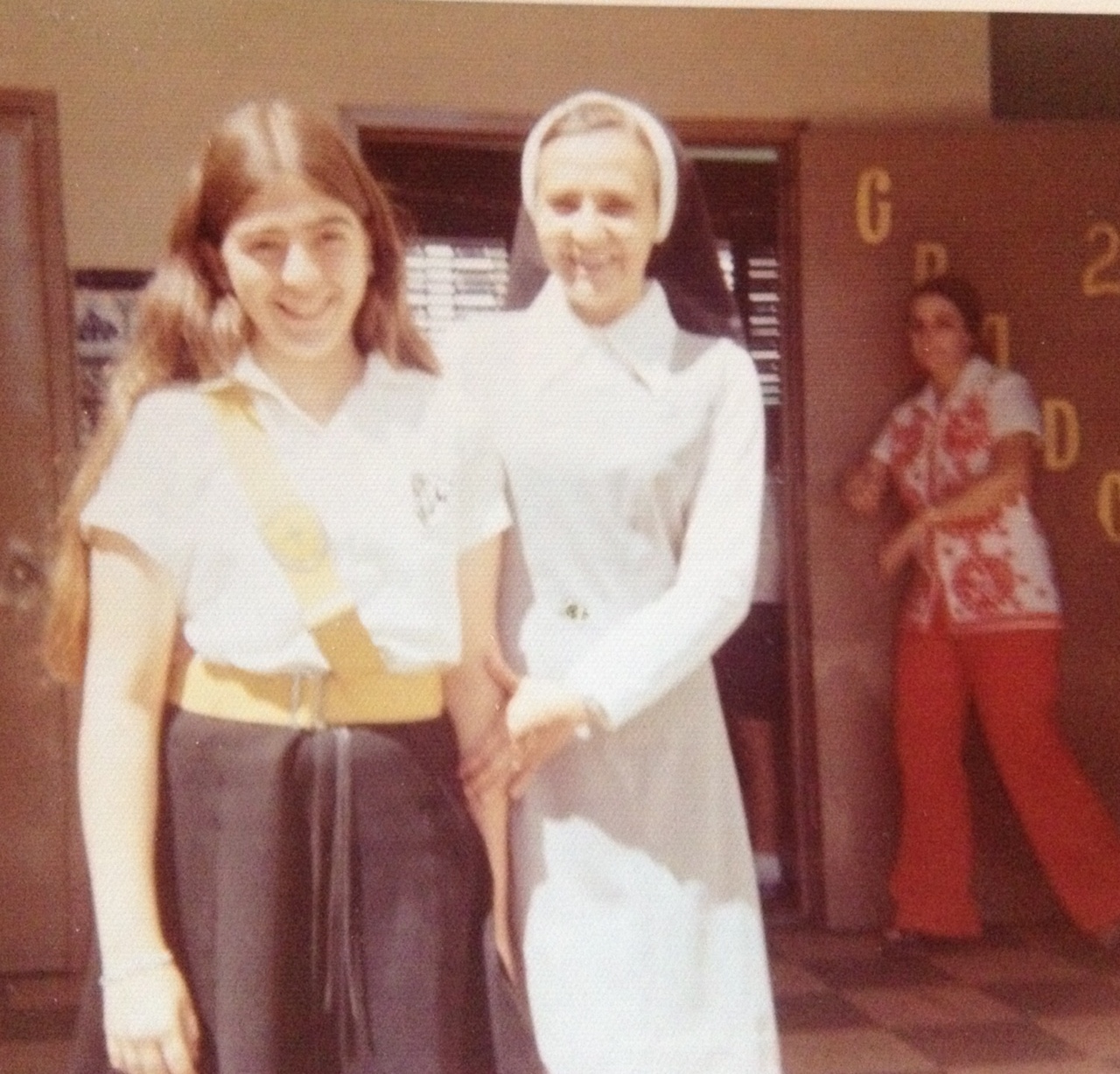
I am often struck by the reality that, unlike most friends my age, I did not experience the trauma and upheaval of the 1960s culture and the changing Catholic Church that they describe in the United States. Instead, the Cursillo movement, energized by reforms of the Second Vatican Council—brought increased vitality and renewal to the Catholic Church of Puerto Rico, a stunning tropical island in the edge of the Caribbean.

In Cuba, both of my parents had been Catholic-school teachers in my hometown of Pinar del Rio until Fidel Castro shut down and appropriated the diocesan buildings. Within months, Castro’s militia collected the sisters and priests that had been serving in these schools—my parents’ friends—and ejected them from the country. A group of 300 priests was amassed without explanation, put on a boat, and shipped to Spain. For years my parents and their friends began every conversation comparing notes regarding the location where these religious women and men had been sent.


Largely through the encouragement of these relocated women religious and other Cuban priest friends, I watched my parents’ life evolve from living as newly arrived refugees to immigrants making a new life and home in Puerto Rico. My parents brought with them the energy of their experience as leaders of Pinar del Río’s Juventud de Acción Católica, Catholic Youth in Action, joining Puerto Rico’s Cursillo movement and organizing activities and ministries through the schools and parishes. And they took my brother Ignacio and I everywhere they went. We visited prisons. We collected and repaired toys for needy children.  We attended fund-raising concerts for underprivileged schools. We traveled hours through the island’s windy roads to events hosted by their friends to support their ministry. We hosted organizing meetings in our undersized living room, usually accompanied by my grandmother Josefita’s cooking—just as it would have been done in Cuba.

Looking back on those early years of my life, I am amazed by the reality created by my parents. If having nuns and priests regularly in our house and as part of our activities was weird, I never knew it. It was simply my normal kind of weird! How could I have known that other families didn’t function this way?

I have no stories of nuns with punishing rulers and chastising practices. My experience in Puerto Rico with sisters and nuns, both in Catholic schools and daily life, were enticing and inviting enough to place a seed of desire in my heart for a vowed religious vocation.

Sor Presentación taught me reverence and the reason why we kneel and bow in church. I learned to ask “why” as a way of growing in my faith. My principal Sor Pilar loved to tell me jokes while I waited for my mom to be done with her school work. I learned nuns were funny, real, and loved to have fun. Sor Isabel let me help her in the kitchen. I learned that even nuns had to do chores, clean house and do laundry. And Sor Marta, my mom’s best friend from childhood, invited me as a teenager to come visit and stay in the convent overnight.  I learned that nuns were not just idols, but people who considered me a friend.


The love, dedication, vision and passion for religious life that I witnessed in these women not only enhanced, but also intrinsically shaped my knowledge and experience of the Catholic faith. To them I owe the structure, the roots, within which I built a personal and intimate relationship with Jesus as a young adult.