 |
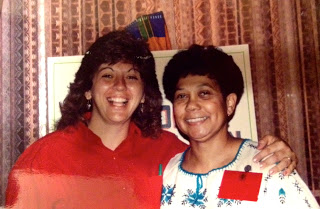
| Sister Tess and I at the 1992 7th National Black Catholic Congress in N.O. (I was on assignment and she was attending!) |
A few years ago I wrote an essay titled "Mi Hermana Tess" about my admiration for and friendship with Sister Tess Browne, a member of the Sisters of Charity of Nazareth, Kentucky.
The essay was published in a book that I've mentioned before -- "Thank you Sisters: Stories About Women Religious And How They Enrich Our Lives" -- a very appropriate text for this week, National Catholic Sisters Week!
The essay was published in a book that I've mentioned before -- "Thank you Sisters: Stories About Women Religious And How They Enrich Our Lives" -- a very appropriate text for this week, National Catholic Sisters Week!
Edited by my friend and colleague in the Catholic press John Feister, the book is a collection of 12 essays written by several famous people:
Cokie Roberts; Maureen Orth, award-winning journalist and special correspondent for Vanity Fair; Sr. Helen Prejean; James Martin, S.J.; best-selling author Adriana Trigiani... and more.
And as I've joked and pointed out since the beginning, I am, clearly, one of the"and more" -- although this "filler writer" is nothing but honored and grateful to have been included in this great project!
I have posted before an excerpt from that essay describing when I first met Sister Tess at the University of Texas Catholic Student Center. You can read that blog here.
Today I'd like to post a different part of the essay, from a conversation I had with Sister Tess when our group of college students (including the guy I was dating and later married!) from the Catholic Student Center went to witness the work of her community with the United Farm Workers in South Texas.
Don't laugh too much -- here's what we looked like in 1980. The summer before I turned 20!

¡Si se puede!
University Catholic Center students visiting farm workers in South Texas,
with Sr Tess Browne, who was working with the United Farm Workers, 1980.
(Can you make out Michael and I in the front row?!)
+ + +
Listening to Tess’ stories, I was a bit star-struck. Like a female Tom Hanks in the movie “Forrest Gump,” Tess’ life casually crossed paths with significant moments in history. Picketing alongside Cesar Chavez. Civil rights marches. A sit-in with Dorothy Day...
Tess frequently shocked me, provoked me, and in a very real way, inspired me. As a Hispanic privileged enough to be attending college, I felt a special responsibility to learn more, to do more for these people, my people.
So when she invited students interested in visiting the Rio Grande Valley to come learn more about the work of the United Farm Workers and the life of farm workers in south Texas, I jumped at the opportunity.
Our group’s visit to the border towns of San Juan and McAllen is a blur in my memory. I remember going to UFW rallies, and being the one to introduce our students in Spanish to the farm workers gathered that night. I remember celebrating daily Mass and prayers with our hosts, Tess’s co-ed religious community. But what stands out the most in my memory is the intense feelings I had throughout that weekend.
It was my first time to encounter a situation so tragic, so horrible, so challenging, that I felt completely powerless and ultimately, deeply angry. I was livid about living conditions of children and their families in the colonias—dirt streets, no running water, houses that were truthfully shacks. It was like being in a third world country. I was broken hearted and infuriated conversing in Spanish with young women my age who had already lived profoundly painful lives. And in all honesty, I was irritated with my own ignorance, for not knowing this existed just five hours from my home.
Sitting by myself in the community’s chapel one night, I cried weakly in my seething anger. Sr. Tess walked in and just sat next to me, waiting until I could speak. When she sensed that I was ready, she grabbed my hand and looked at me.
“How do you do it?” The words stumbled clumsily. “How can you do this work and see all this, every day, and not be consumed by the anger?”
Without hesitation, Tess began, “*I* don’t do it. I offer up my day every morning to the One who can make a difference, and I leave the details up to God,” she paused but continued to look intensely at me.
“I come to the Eucharist daily and let it heal me. And every night, I leave my anger, frustration, hopelessness, despair, right here, at the foot of the altar. I am not the maker, María, I am the instrument.”

With Sister Tess, a mini-reunion of our University Catholic Center
UFW group (with Jean Perdicaris, Sandra Derby, Michael Scaperlanda)
at my daughter Michelle's wedding, July 2012


